On collaborating with her dog

Charlie the Dog Pilgrim with GPS tracker and bells
The poet and environmental activist Susie Campbell contacted me in 2023 at the start of her project, when her dog Charlie was still a puppy and her project along the Pilgrim’s Way in West Surrey (UK) was wanting to find its compass. I was delighted to coach this project in its initial phases.
Two years later, it is out in bookform as Wastelands. Her pieces are a direct result of her research and material processes: local digging, autobiographic tracings, cultural geologies, activist commitment, visual tracings, photographic excavations. A deeply hybrid and purpose-led method that she calls her “waste poetics”: “a layered, unstable, and lively space of loss, damage and detritus”.
It also brings forward her active and unusual collaboration with her dog Charlie as tracker. She shared with me some work in progress materials and answered a couple of questions about this particular aspect of her process.
I asked Susie to share with us some excerpts, process shots and notes.
On Charlie, her Dog Pilgrim, Susie writes:
Encouraged by Caroline’s support, I collaborated with my dog Charlie to explore alternative ways of navigating a place profoundly changed by industrial extraction and landfill, tracing Charlie’s movement patterns, recorded by his GPS tracker and the sound of his collar bells, and developing a ‘waste poetics’ suggested by the decomposing textile waste he helped me dig up.
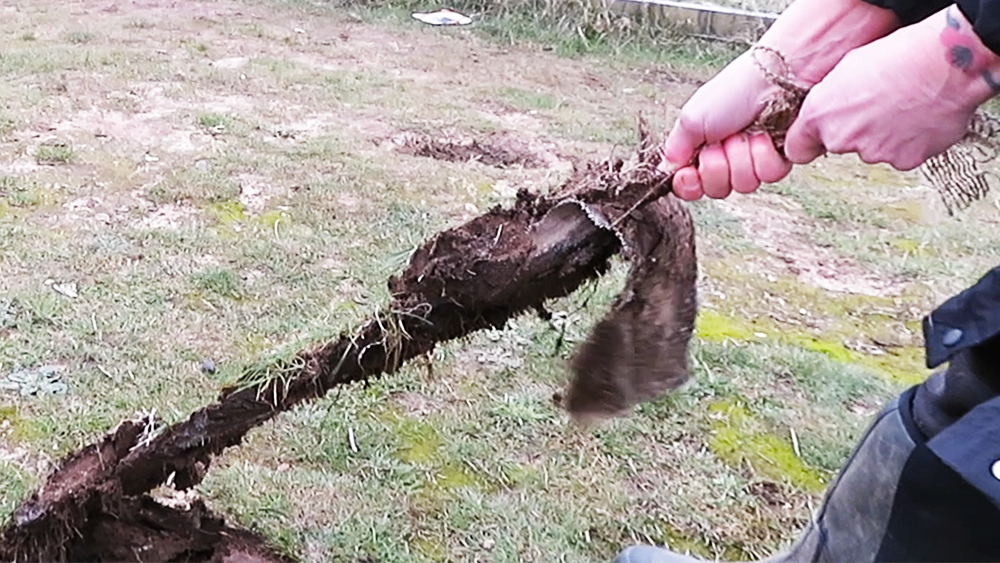
Susie Campbell retrieving textile waste from the closed landfill discovered by Charlie. Filmstill from work in progress towards Wastelands (2025).
On the resulting sequence “Dog Pilgrim”:
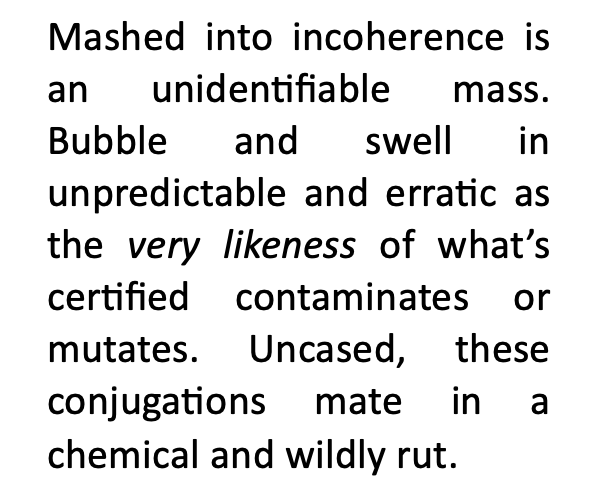
‘Dog Pilgrim’ was made in collaboration with Charlie. The poem seeks ways of mapping, that which is no longer there, exposing its supposed Ordnance Survey map coordinates as a nonsense (‘all points float across a void’), using them instead as magical or musical notation.
The wasteland that emerges is mythological, spiritual, and cultural, as well as literal.

from “Dog Pilgrim”
from “Waste Poetics”
What it means to be working with Charlie:
CB: Beyond the activist retrieval in the field, can you tell me what working with Charlie did for the writing process itself?
Susie: The challenge of how to incorporate my notations of Charlie's movements within the written text had a significant impact on how I approached the page itself. I was already thinking of the long poem form as a textual environment but the spatialities of the ‘Charlie notations’ pushed me to rethink the whole space of the page itself.
This also opened up options for exploring the directionality of the text. I have for some time been fascinated by the multi-directionality of some of Gertrude Stein's sentences and so I was excited when I realised that the Charlie marks might offer alternative reading directions and orderings. This was quite a radical liberation of my approach to the page.
Working with Charlie seemed to release what I might describe as a 'trickster' energy in the writing process. What happens on the page is rooted in some of the more intuitive communications between myself and Charlie.
CB: Do you think this specific way of collaborating carries other long term impact for your work ?
Susie: Well, since completing Wastelands, I have adopted a second rescue dog and so there are all sorts of possibilities now for collaborating, thinking and acting as a 'pack' which might be different from a single human-animal collaboration. This is very exciting for me as a way into exploring different spatialities and temporalities, and ultimately new, more-than-human grammars.
After collaborating with Charlie, this is not just a landscape haunted by human oppression but also by ghosts of the other-than-human, like spectral flocks of sheep.
My current work-in-progress explores the impact of the medieval wool trade on what becomes the ‘wastelands’ landscape, looking at land enclosures, the impact on the natural and social environment etc.
Wastelands is out with Guillemot Press.
@susiecampbellwrites
Caroline Bergvall, 24 oct 25